


Key Takeaways:
- Northern Hemisphere method: Point the hour hand at the sun, find halfway between it and 12 o'clock, that line points south
- Southern Hemisphere method: Point 12 o'clock at the sun, find halfway to the hour hand, that line points north
- Adjust for summer time: Subtract one hour mentally before starting (BST, DST, etc.)
- Best accuracy: Works well in mid-latitudes like the UK when sun or shadow is visible
- Tritium advantage: NITE watches remain readable in poor light, fog, or dense cover, critical when conditions deteriorate
- Mark your bearing: Use a rotating bezel to lock north/south once found, maintaining direction whilst moving.
Finding South in the Northern Hemisphere
If you're in the UK, Europe, North America, or anywhere north of the equator, this compass method finds south. North sits directly opposite.
Step-by-step compass technique:
- Hold your watch flat with the dial facing up
- Point the hour hand directly at the sun (if shadows are visible but the sun isn't clear, aim the hour hand at the brightest part of the sky)
- Locate the point exactly halfway between your hour hand and the 12 o'clock marker
- That imaginary line running from the centre through this halfway point indicates south
Simple.
One thing catches people out: if you're on British Summer Time or any daylight saving scheme, mentally subtract an hour first. So if your watch reads 15:00 BST, treat it as 14:00 for this calculation. Summer time shifts the relationship between solar position and clock time, throwing your compass bearing off by roughly 15 degrees if you ignore it.

The geometry works because the sun crosses the sky at approximately 15 degrees per hour. Your watch dial represents a 12-hour span, so the alignment creates reasonably accurate compass readings. In practice, enough to get you heading the right direction when maps and GPS aren't available.
Field watches like the MX10 were built for exactly this sort of work. Clear, uncluttered dials with distinct hour hands make the compass technique straightforward even when you're cold, tired, or under pressure. In the field, when the MX10 was supplied to UK Special Forces, readability wasn't negotiable. Learn more about military field watch features that support survival navigation.
Finding North in the Southern Hemisphere
Australia, New Zealand, South Africa, southern South America. The compass method flips but the principle stays consistent for wilderness navigation.
Hold your watch flat, dial up. Point the 12 o'clock marker at the sun. Find the halfway point between 12 o'clock and wherever your hour hand currently sits. That line indicates north. South lies opposite. Adjust mentally for any daylight saving offset before you start.
Why Summer Time Matters
This catches people out more than anything else. During British Summer Time, your watch reads one hour ahead of solar time. That offset skews your bearing by roughly 15 degrees. Enough to send you significantly off course over distance.
When BST is active (late March through late October in the UK), think one hour earlier. Your watch shows 16:00? Use 15:00 for the calculation. Countries using different daylight saving schemes follow the same logic. Standard time (GMT, UTC, etc.) needs no adjustment.
When This Technique Works Well
This isn't a replacement for a proper compass. What it provides is general direction. Accurate enough to walk towards a road, coastline, valley, or known landmark, but not precise enough to hit a tiny feature.
Best results come in mid-latitudes. Britain sits perfectly in this range. Between 40 and 60 degrees north or south, the sun's arc across the sky creates reliable geometry for the method.
You need some indication of where the sun actually is. Direct sunlight works. Even light cloud that creates faint shadows or shows a brighter patch of sky gives you enough. Our testing shows thick fog, heavy forest canopy, or complete overcast removes the reference point entirely. There's no getting around that.
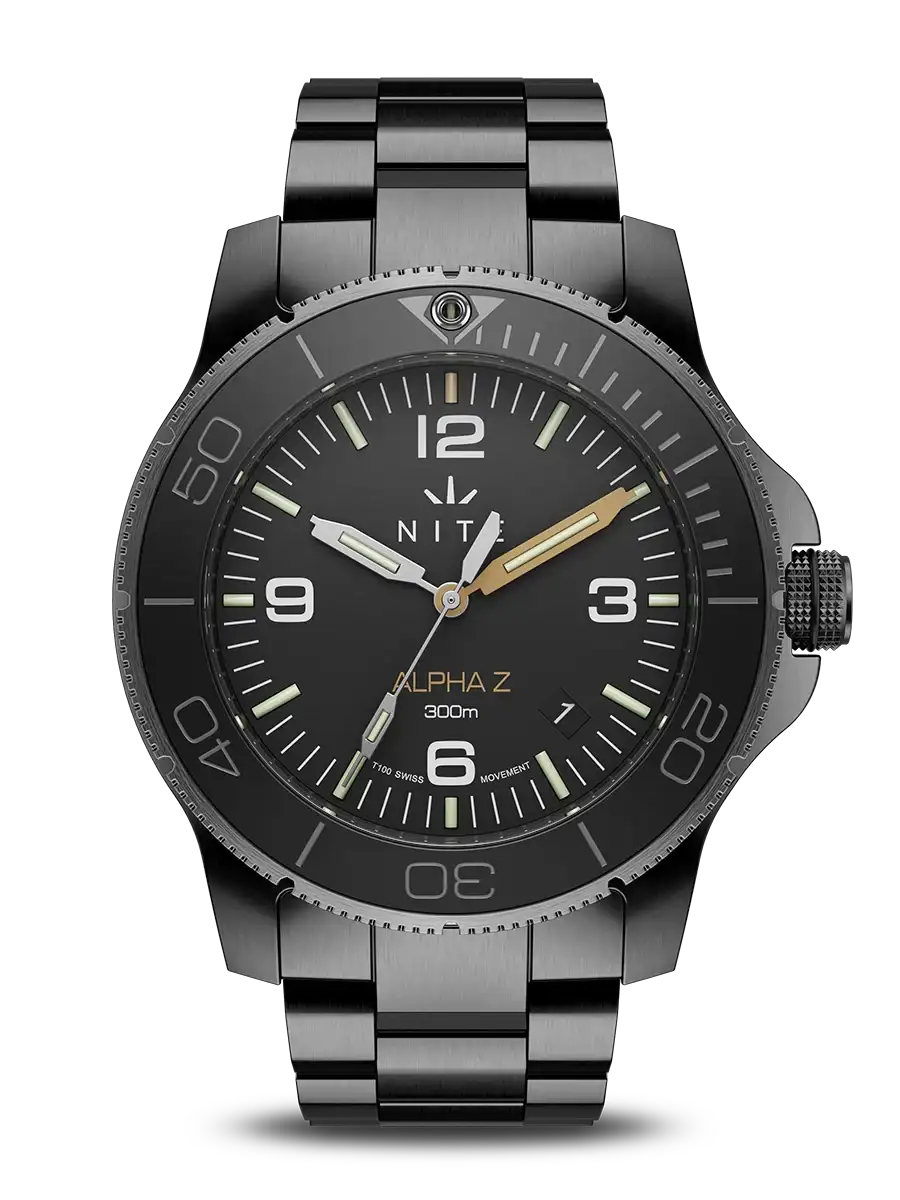
Why Watch Visibility Matters for Compass Navigation
Standard luminous paint might look adequate in a brightly lit shop. Twelve hours into wilderness navigation during deteriorating weather, that paint has faded to nothing. We've seen it happen.
Tritium illumination solves this. The gas-filled tubes glow constantly for up to 20 years without charging. No need to expose the watch to light first, no fading overnight, no batteries required.
When you're trying to use this survival compass technique at dawn, dusk, or under heavy tree cover, you need to see your hour hand and 12 o'clock marker clearly. Operationally, it's that straightforward.
NITE's T25 and T100 options both maintain visibility in conditions where traditional lume fails. Performance wise, the MX10 uses T25, sufficient brightness for tactical situations where discretion matters. The Alpha dive watch features T100 for maximum brightness, whether you're underwater or operating in complete darkness. That's when every second counts.
Using a Rotating Bezel to Lock Your Bearing
Once you've determined which direction is north (or south), you need to maintain that bearing whilst moving. Trying to remember "north was sort of that way" whilst scrambling over rough ground doesn't work.
Dive watches with rotating bezels, like the Alpha series with 300m water resistance, let you mark your compass bearing permanently. After finding north using the watch compass technique, rotate the bezel until its triangle or zero marker aligns with north on your dial.

You've created a fixed reference. As long as you keep that bezel marker pointing in the same absolute direction whilst you walk, you maintain your bearing. Glance at your wrist periodically to check you haven't drifted off course. Field tested, proven to work.
How Accurate Can You Expect?
Realistically, this method gets you within 10 to 20 degrees of true direction under good conditions. Not precise enough for orienteering competitions, but adequate for getting yourself back to a road, river, coastline, or valley when you've become disoriented in the wilderness.
Your latitude influences accuracy. The further you are from mid-latitudes, the less reliable the method becomes. Near the equator, the sun rises nearly straight up. In far northern regions, the sun barely rises in winter.
How precisely you align your hour hand with the sun matters. Being off by a few degrees here translates directly to error in your final bearing. Worth taking a moment to get this right. Use shadows if the sun itself is too bright to look at directly. Improves results noticeably.
Practising the Technique Before You Need It
Walking into unfamiliar terrain hoping you'll remember this survival compass technique when things go wrong is optimistic. Emergency navigation skills require practice. Practise deliberately a few times so the steps feel automatic.
Pick a sunny day, head to your local park, and run through the compass method. Use your analog watch to find south, then check with an actual compass or GPS bearing. Try it at different times to understand how the geometry shifts.
After a few repetitions, the sequence becomes muscle memory. Under pressure, when your GPS has died and visibility is deteriorating, you're running on practiced routine. That's the difference between kit that works and kit that fails.
Real-World Limitations to Understand
This technique can't do everything. It won't navigate you accurately through dense forest with no clear sight of the sky. It becomes unreliable very near the equator or in polar regions. From experience, it gives approximate direction for backcountry navigation, not precision bearings.
If you're planning serious wilderness travel, carry proper navigation equipment (map, compass, GPS) and know how to use them. This watch compass method is a backup for emergency situations when those primary tools fail. Know your equipment, know its limits.
FAQ
Does this watch compass method work in the tropics near the equator?
No, not reliably. The sun rises nearly straight up and sets nearly straight down near the equator, removing the predictable arc across the sky this compass method depends on. Best accuracy sits between 40 to 60 degrees latitude north or south. The UK sits perfectly in this range.
How often should I recheck my bearing whilst walking?
If you've marked north with a rotating bezel, you can navigate for extended periods without rechecking. Glance at your wrist every 10 to 15 minutes to confirm you're maintaining the correct direction relative to your bezel marker.
What's the biggest mistake people make with the watch compass method?
Forgetting to adjust for daylight saving time. This throws your compass bearing off by roughly 15 degrees, enough to send you significantly off course. Always subtract one hour mentally if you're on summer time (BST, DST, etc.) before starting the technique.
Will this work with any analog watch or does it need to be a NITE?
The watch compass technique works with any analog watch that has hour and minute hands. Tritium illumination becomes critical in poor light conditions (dawn, dusk, heavy weather, or under forest canopy) where you need to see your dial clearly. When it matters, traditional luminous paint fades within hours of darkness, removing this capability precisely when compass navigation becomes most difficult.


