


Key Takeaways
- Complete darkness is essential: 10 to 15 minutes of dark adaptation in absolute darkness is required for accurate tritium testing
- Even glow signals health: All tritium tubes should glow evenly within each colour, dead tubes mean a problem
- Half-life is normal physics: Tritium reaches 50% brightness at 12.3 years, this is expected aging, not a defect
- Colour affects brightness: Green tritium glows brightest, followed by blue, white, and orange in decreasing visibility
- Know the warning signs: Uneven dimming across tubes points to tube failure, whilst gradual uniform dimming is expected
Why Testing Your Watch's Illumination Matters
You've invested in a British watch with Swiss tritium tubes because you need visibility that doesn't fade. Testing verifies your GTLS tubes still function properly and helps distinguish normal aging from genuine defects.
Green tubes at 50% brightness (12 years old) still outperform new blue tubes. Understanding colour performance prevents mistaking optical science for tube failure.
How to Test Tritium in Complete Darkness: Step-by-Step
Testing Checklist: □ Find windowless room (bathroom, basement, cupboard) □ Remove all light sources (phones off, cover LEDs) □ 15min eye adaptation in complete darkness □ Check: Can you read the time? □ Check: All tubes glow evenly within colour?
Your eyes need 10 to 15 minutes to reach maximum rod cell sensitivity. Any ambient light resets this adaptation process and makes even bright green tubes appear dim.
What Functional Tritium Should Look Like
Working tubes show even glow within each colour group. All green markers equally bright, all blue markers consistent. Watch for steady, continuous glow without pulsing or flickering.
Colour consistency matters. Green stays green (520nm), Ice blue stays ice blue (455nm), white stays neutral. Yellowing signals phosphor degradation. Single dead tube in <5yr watch = manufacturing defect requiring professional replacement.
Tritium Watch Colour Comparison: Green vs Blue vs White Brightness
| Colour | Brightness | Wavelength | Best For | Warning Signs |
|---|---|---|---|---|
| Green | 100% | 520-530nm | Maximum visibility | Yellowing, dimming in <10yrs |
| Ice Blue | 72% | 455nm | Tactical operations | Purple shift, dead tubes |
| White | 68% | Neutral | Classic aesthetics | Yellow tint, uneven glow |
Human eye scotopic vision peaks at green wavelengths, making green tubes appear brightest. Blue tests at 72% green brightness, white at 68%.
Green Tritium: Maximum Visibility

Hawk Nightfall: Green T100 tubes deliver maximum night visibility for tactical dive operations.
Tritium Half-Life Explained: What to Expect at 12 Years
The 12.3-year half-life means 50% brightness after 12.3 years, 25% after 24.6 years. This is normal radioactive decay, not failure.
Expected Brightness by Age:
- 0-5 years: 100%-80% (imperceptible degradation)
- 5-10 years: 80%-65% (minimal visible change)
- 10-15 years: 65%-45% (obvious but functional)
- 15-20 years: 45%-25% (dimmed, still readable)
- 20+ years: 25%-10% (end of functional lifespan)
<5 years & can't read time after 15min darkness = manufacturing defect. GTLS watches last up to 20 years with functional visibility.
Blue Tritium: Tactical Performance
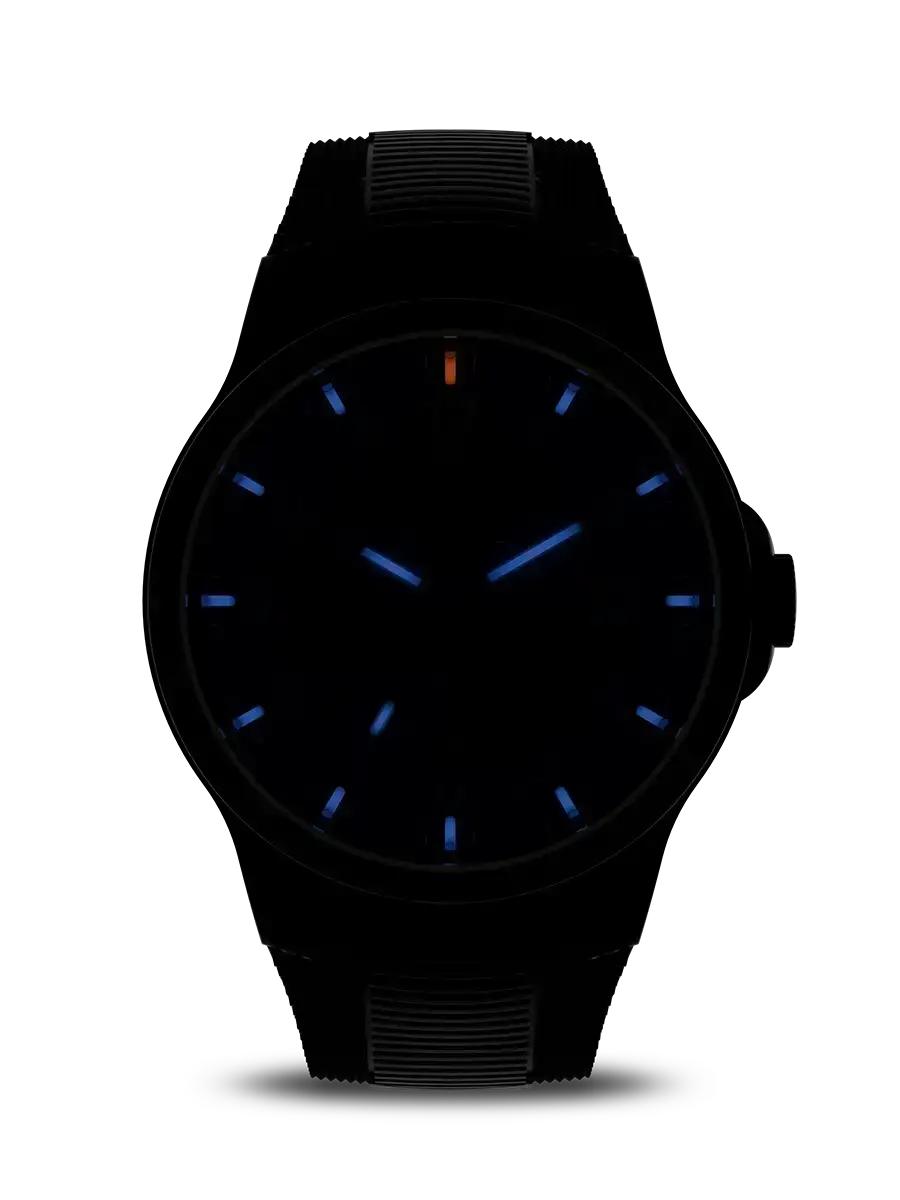
MX10 Horizon: Blue tritium field watch built for operational conditions.
Warning Signs: When Tritium Tubes Need Replacement
Quick Diagnostic:
- All tubes dim equally? → Normal aging (check age chart above)
- One tube dead? → Manufacturing defect (contact Nite)
- All tubes dead? → Testing error (retry in true darkness)
- Tubes yellowing? → Phosphor degradation (replacement needed)
- Uneven brightness same colour? → Selective tube failure
- Premature dimming (<10 years)? → Investigate defect
Complete invisibility in watches under 20 years means testing technique issues or genuine tube failure requiring professional assessment.
White Tritium: Classic Elegance

Alpha Crest: White T100 tritium with sophisticated dive watch aesthetics.
Tritium Replacement Options: Repair vs Upgrade
Option 1: Professional Tube Replacement
GTLS tube replacement requires specialist service. Watches under warranty: contact us immediately. Out-of-warranty: consider replacement cost vs new watch value.
Swiss mb-microtec manufactures GTLS tubes to ISO standards, ensuring consistent performance and safety compliance.
Option 2: Upgrade to Fresh Tubes
New Nite watches feature fresh Swiss mb-microtec T100 tubes with 20-year lifespan. Hawk Nightfall (green), MX10 Horizon (blue), Alpha Crest (white).
Contact our team for replacement guidance or browse our full collection.
FAQ
How long should I wait in darkness before testing tritium?
15 minutes minimum for full rod cell adaptation. Scotopic vision requires complete dark adaptation to detect low-level luminance (0.5-2 cd/m²).
Is it normal for tritium to be dimmer than luminous paint?
Yes. GTLS glows at 0.5-2 cd/m² continuously for 20 years vs lume's 300+ cd/m² for 30 minutes only. Different purposes: constant visibility vs peak brightness.
What does the half-life mean for my watch?
12.3-year half-life = 50% brightness reduction. Years 0-10: imperceptible change (100% → 85%). Years 10-20: visible dimming but functional. Normal physics, not defect.
Can dead tubes be replaced?
Yes, by qualified watchmakers with dial removal and specialist tools. Not DIY-repairable. Contact us for service assessment and cost estimate.
How do I know if dimming is normal or a problem?
Normal: All tubes dim equally by age (50% at 12 years). Problem: Single dead tube, uneven brightness same colour, excessive dimming in <10yr watch, yellowing/colour shifts.
What's the difference between T25 and T100 brightness?
T25: ≤25 millicuries per tube (lower output, regulatory compliance). T100: 25-100 millicuries (maximum legal brightness). Both perform reliably, T100 offers 2-4x brighter visibility.


